Published 2026-11-12 · Kama'aina Locksmith
Quick Answer
Smart lock vs keypad lock: which is better for a Hawaii rental? For most vacation rentals, a smart lock with a keypad is the more practical choice because you can change guest codes without meeting someone to hand over a key. For a long-term rental or a unit with simple access needs, a standalone keypad lock may be the better fit.
Key Takeaways
- A standalone keypad lock is straightforward.
- A lock that works well in a dry inland market may need more attention on Oahu.
- Before choosing any electronic lock, check what is already on the door.
- Electronic access does not replace the need for a sound door and deadbolt.
- For a short-term rental with frequent check-ins, choose a keypad-equipped smart lock if the building allows it and you are willing to manage codes and batteries.
Overview
Smart lock vs keypad lock: which is better for a Hawaii rental? For most vacation rentals, a smart lock with a keypad is the more practical choice because you can change guest codes without meeting someone to hand over a key. For a long-term rental or a unit with simple access needs, a standalone keypad lock may be the better fit.
The key detail is that these are not always two separate choices. Many smart locks have a physical keypad on the outside. A keypad lock lets someone enter a code at the door. A smart lock adds remote management through an app, Wi-Fi, Bluetooth, or a connected hub. The right setup depends on how often people change, who needs access, and how well the lock can handle Oahu's humidity and salt air.
Smart Lock vs Keypad Lock for a Hawaii Rental
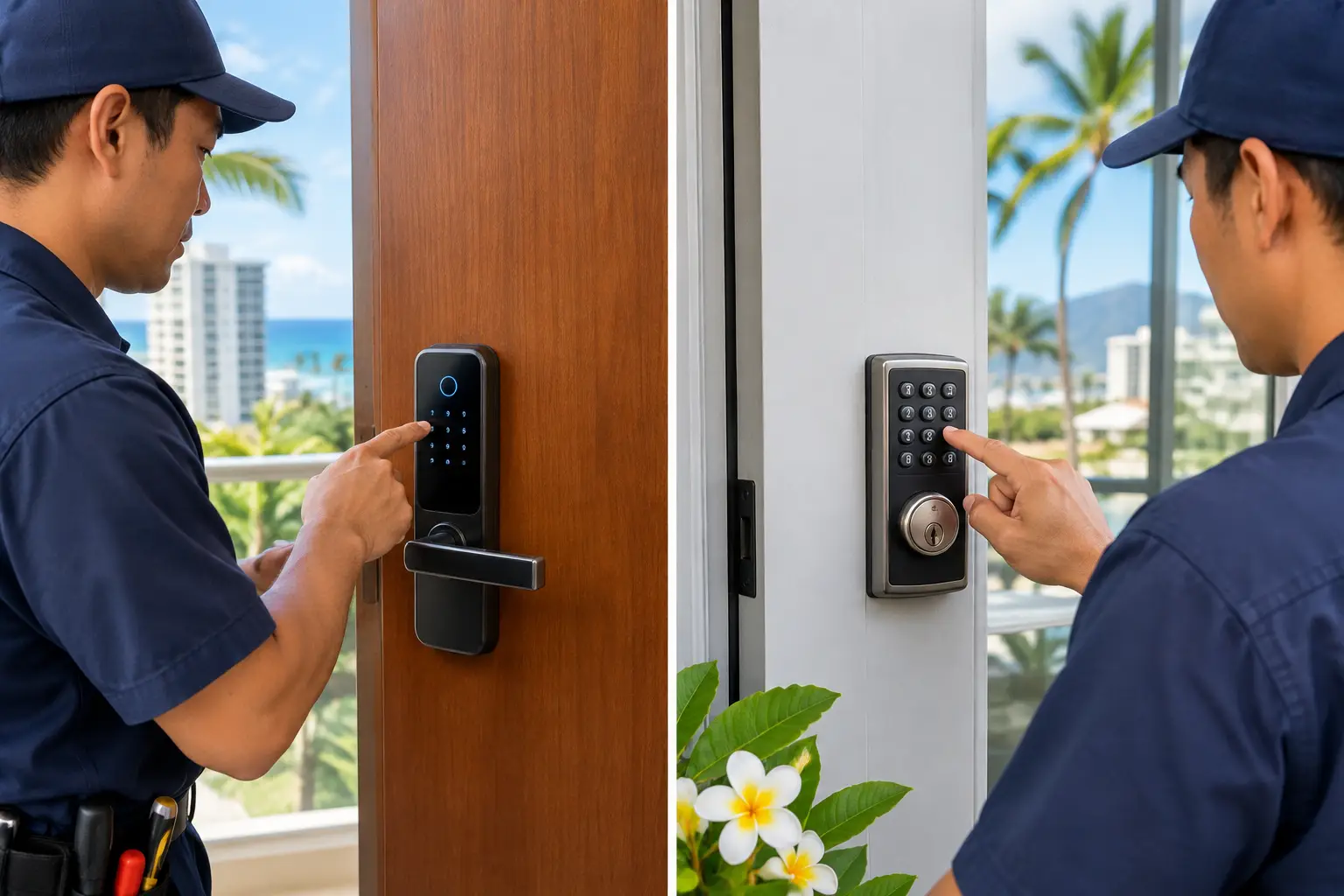
A standalone keypad lock is straightforward. You program one or more codes directly at the lock, and the lock opens when the correct code is entered. It may run on batteries and may also have a key cylinder for backup. There is no app to manage and no internet connection required.
A smart lock can also use a keypad, but it gives you more control from a distance. You can typically create individual codes, set a code to work only during certain dates or hours, and remove a code after a guest leaves. Some models also keep an activity record showing when a code was used.
For a Waikiki condo with frequent guest turnover, that remote control can reduce a lot of coordination. If a guest arrives late or a cleaner needs access between stays, you can assign a separate code instead of circulating one physical key. For a rental in Kailua, Kaneohe, or Hawaii Kai that has the same tenant for a year or more, the extra connectivity may not add much value.
Choose a smart lock when turnover is frequent
A smart lock usually makes sense for a short-term rental, furnished corporate rental, or property where several people need separate access. You can create a code for each guest, cleaner, maintenance person, or property manager and remove it when it is no longer needed.
This is especially useful when you do not live near the unit. A host in Mililani managing a Kakaako condo, for example, may not want to drive across the island whenever a guest needs a new code. Smart features can make access easier to manage, but only if you stay on top of the app, battery alerts, and user permissions.
A smart lock also helps when you want to avoid rekeying after every short stay. Rekeying means changing the internal pin arrangement in a traditional lock so old keys no longer work. It is still a sensible security step after a long-term tenant moves out, but rotating temporary codes is more convenient between regular guest stays.
Choose a keypad lock when simple is the priority
A standalone keypad lock can be a solid choice for a long-term rental, an owner-occupied home with a separate rental unit, or a property where internet service is not consistent. The tenant gets a code, and you avoid managing apps, online accounts, hubs, and remote notifications.
It can also be easier for guests who are not comfortable with phone-based entry. A keypad is familiar: enter the code, turn the handle or thumbturn, and go inside. There is no need to download anything or pair a phone.
The trade-off is management. If you have one shared code for multiple people, you do not know who used it. You also need to be physically present, or have someone trusted at the property, when it is time to change programming on many basic keypad locks. Some keypad models store several codes, but their scheduling and remote controls are usually limited.
Hawaii Conditions Matter More Than Most Hosts Expect
A lock that works well in a dry inland market may need more attention on Oahu. Salt air, humidity, wind-driven rain, and sunscreen or sand on hands can all affect exterior hardware over time. This matters in oceanfront areas, but it can also matter at condos near Ala Moana and properties throughout the island.
Look for exterior hardware suited to the location and inspect it regularly. Corrosion can affect screws, strike plates, key cylinders, battery contacts, and the moving parts inside the lock. A strike plate is the metal piece on the door frame that receives the latch or deadbolt. If it loosens or corrodes, even a good lock can become hard to operate.
Battery maintenance is also not optional. Most electronic locks give low-battery warnings, but a busy host can miss them. Replace batteries on a schedule rather than waiting for a warning. Keep the backup entry plan current as well, whether that is a mechanical key held by the owner or property manager, an approved emergency contact, or another authorized method allowed by the building.
Do not assume a smart lock will work normally during an internet outage. The keypad and lock mechanism typically still operate locally on battery power, but remote changes and app notifications may not work until the connection returns. Guests should always receive a clear code and simple entry instructions before arrival.
Check the Door, Building Rules, and Exit Requirements First
Before choosing any electronic lock, check what is already on the door. Many Hawaii rentals have a deadbolt above a separate handle, while others use a single connected lockset. The door thickness, backset, hole placement, condition of the frame, and existing hardware all affect which lock can be installed properly.
Condo and high-rise rules matter, too. Some associations require approval before exterior hardware is changed, especially when a lock changes the appearance of the hallway-facing door or connects to a building access system. In Waikiki, Downtown Honolulu, and Kakaako towers, confirm the rules before ordering hardware or scheduling installation.
You also need to preserve safe exit from inside the unit. Residents and guests should be able to leave without needing a code, app, or key. Do not add a device that interferes with the door's normal operation or building requirements. A locksmith can inspect the existing door and explain whether the planned lock fits the hardware and the intended use.
Do Not Ignore the Mechanical Lock
Electronic access does not replace the need for a sound door and deadbolt. A smart lock mounted on a loose door, a weak strike plate, or a misaligned frame will still have problems. Humidity can swell wood doors, and heavy use can shift hinges or wear the latch opening over time.
For many rentals, the practical setup is an electronic deadbolt paired with a properly aligned door and a clear backup plan. If the property has a physical key override, decide who holds that key and where it is kept. Avoid leaving a spare in an obvious outdoor location. If the rental has recently changed hands or a long-term tenant moved out, consider rekeying any remaining mechanical locks at the same time.
A Practical Choice by Rental Type
For a short-term rental with frequent check-ins, choose a keypad-equipped smart lock if the building allows it and you are willing to manage codes and batteries. Give each guest a unique temporary code, and keep separate codes for cleaners and maintenance.
For a long-term rental, a standalone keypad lock may be enough if you want simple code access and do not need remote controls. If the tenant prefers a traditional key, a quality deadbolt that is rekeyed between tenancies remains a practical option.
For a condo with strict association rules, start with the building requirements. The lock that has the most features is not useful if it cannot be installed without violating the rules. For a coastal property, put durability and regular inspection ahead of extra app features.
The goal is not to add technology for its own sake. It is to give authorized people dependable access while keeping the door easy to use and the hardware maintained.
If you are planning a keyless entry upgrade, replacing corroded hardware, or rekeying a Hawaii rental after a move-out, Kama'aina Locksmith can inspect the door and discuss practical options for your property. We are bonded and insured, open 24 hours a day, 7 days a week, and serve Oahu. The full price is quoted on the phone before dispatch, and we give you an arrival window when you call (808) 202-3257.
Talk to a local locksmith
Need help now? Kama'aina Locksmith is bonded and insured, open 24 hours a day, 7 days a week, and quotes the full price by phone before a technician is dispatched. Call (808) 202-3257 and we will give you an arrival window for anywhere on Oahu.
Need Help? Call a Local Locksmith
Kama'aina Locksmith: bonded & insured since 2012, with a typical 20-30 min response across Oahu.
Call (808) 202-3257