Published 2026-11-15 · Kama'aina Locksmith
Quick Answer
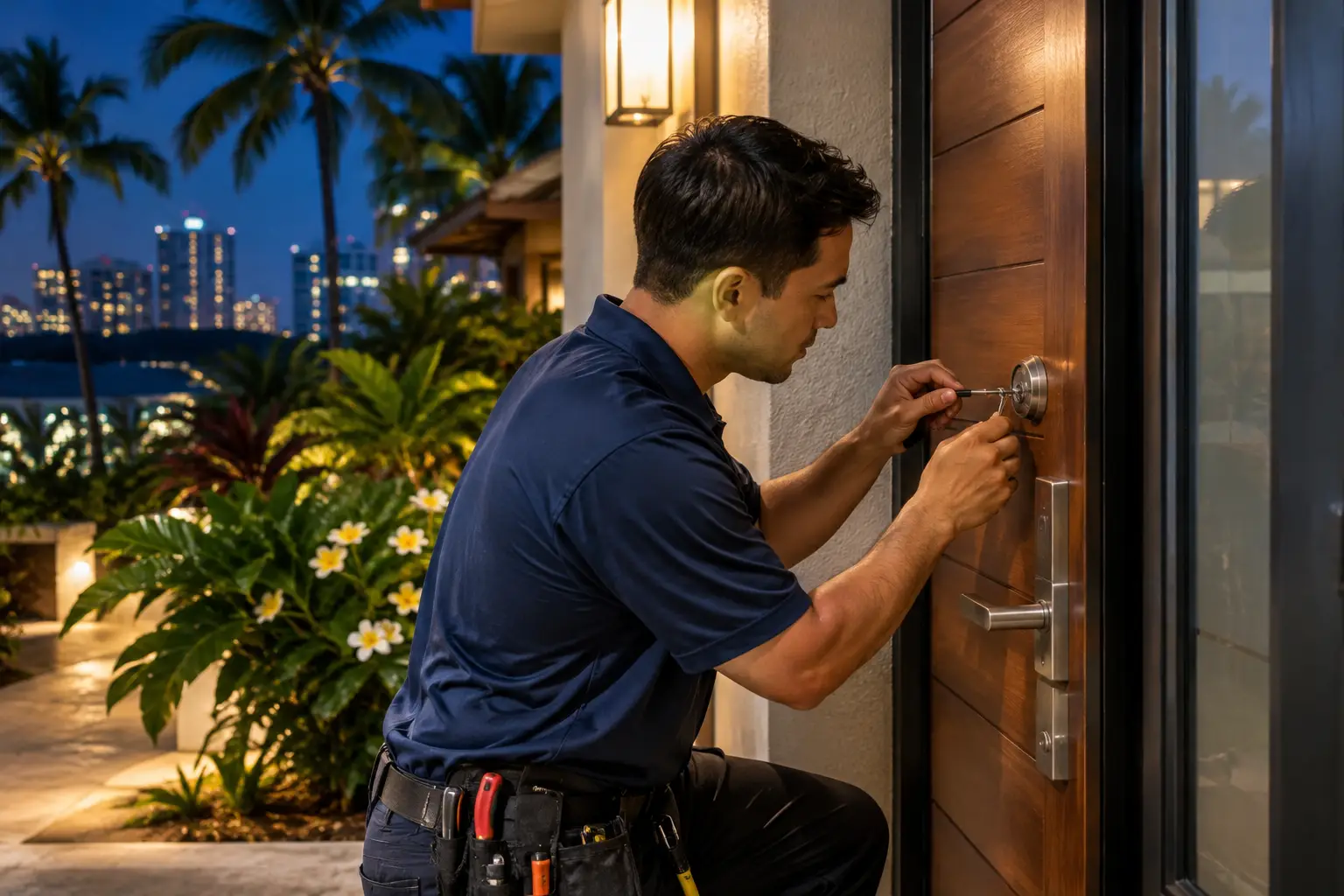
If you are wondering what to do when locked out of your house at night, start by getting somewhere safe and confirming that you truly have no authorized way inside. Then call a reputable locksmith or the person responsible for the property rather than trying to force a door, window, or lock.
Key Takeaways
- First, step away from the door and take one minute to check the basics.
- Who you call depends on where you live and why you are locked out.
- At night, it is tempting to improvise.
- Smart locks add convenience, but they can create a different kind of lockout.
- A child, elderly person, or pet locked inside changes the decision.
Overview
If you are wondering what to do when locked out of your house at night, start by getting somewhere safe and confirming that you truly have no authorized way inside. Then call a reputable locksmith or the person responsible for the property rather than trying to force a door, window, or lock.
A nighttime lockout feels bigger than it is. You may be tired, standing in the rain, carrying groceries, or trying not to wake neighbors in a condo hallway. The goal is simple: stay safe, protect the property, and get back inside without turning a lockout into an expensive repair.
What to Do When Locked Out of Your House at Night
First, step away from the door and take one minute to check the basics. Look for your keys in the car, a bag, pockets, or a jacket you wore earlier. If you live with someone, call them before making another plan. A spare key may be with a roommate, family member, trusted neighbor, or property manager.
Only check entry points you are already authorized to use. An unlocked lanai door, a garage door that normally opens with your remote, or a side entrance you routinely use may solve the problem. Do not climb balconies, remove screens, force windows, or pry at a door. In Honolulu high-rises, those attempts can damage common-area hardware or create a safety issue. In single-family homes, forcing a door can split a frame, bend a deadbolt, or leave the home less secure afterward.
If you are outside in an isolated area, move to a well-lit place nearby if you can do so safely. That might be a building lobby, a neighbor's covered entry, or your vehicle. Keep your phone charged and avoid leaving children, pets, or vulnerable family members unattended while you look for help.
Call the Right Person for Your Property
Who you call depends on where you live and why you are locked out.
If you rent, contact your landlord, resident manager, or property management emergency number first when one is available. Many Oahu condos have building procedures for after-hours access, especially when a locked door separates you from your unit but you are already inside a secured building. The building may require identification, a unit number, or authorization from the owner before allowing anyone to assist.
If you own the home, or your property manager cannot help, a mobile locksmith is usually the practical next call. Describe the door and lock as clearly as you can. Say whether it is a standard keyed knob, a deadbolt, a smart lock, or a keyless keypad. Mention if the key is lost, left inside, broken in the lock, or if the lock simply will not turn.
A legitimate locksmith should ask questions that help establish that you have a right to enter the property. Have a photo ID ready. If your ID is inside, a lease, utility account, vehicle registration showing the address, or confirmation from a landlord may help. The exact documentation depends on the situation, but verifying authorization protects you and the property.
Before anyone is dispatched, ask for the full price to be quoted on the phone, including any service-call fee. For an after-hours home lockout, the price should be clear before work begins. You should also receive an arrival window when you call.
Avoid the Fixes That Cause More Damage
At night, it is tempting to improvise. A credit card, wire, screwdriver, or improvised tool may look like a quick answer in a video, but real residential doors are not all alike. Modern deadbolts, latch guards, reinforced strike plates, and high-security locks are designed to resist casual manipulation. Trying to defeat them can damage the lock, door edge, weatherstripping, frame, or smart-lock electronics.
The same goes for breaking a window or trying to squeeze through a partially open one. Aside from the injury risk, window locks and frames can be difficult to restore properly. Salt air and humidity already take a toll on exterior hardware in places like Hawaii Kai, Kailua, Kaneohe, and Ewa Beach. A corroded lock or hinge may fail further after it is forced.
Do not assume the lock needs to be drilled or replaced. In most cases, a locksmith can first assess the lock condition and use an appropriate method for the situation. Replacement may be necessary when a lock is severely worn, damaged, or corroded, but it should be explained to you before the work moves forward.
If a Smart Lock Is Part of the Problem
Smart locks add convenience, but they can create a different kind of lockout. The batteries may be weak, a keypad code may have been changed, the app may not connect, or a mechanical backup key may be missing. Start with the simple checks: confirm you are using the current code, make sure your phone has service or Bluetooth if the lock relies on it, and ask another authorized user whether settings were recently changed.
Do not repeatedly enter random codes. Many smart locks temporarily disable the keypad after too many incorrect attempts. If your lock has a mechanical key cylinder, do not force a key that does not turn. A bent key, sticky cylinder, or corrosion inside the lock can make the problem worse.
Once you are back inside, consider whether the lock needs service or a better backup plan. A smart lock can be useful for short-term rentals, caregivers, and busy households, but it needs battery checks and a clear plan for emergency access. Condo owners should also check HOA rules before changing exterior door hardware, since fire ratings, door thickness, and shared-building requirements can affect which lock is appropriate.
Special Situations That Need a Different Response
A child, elderly person, or pet locked inside changes the decision. If there is an immediate health or safety concern, call emergency services rather than waiting for a locksmith. Explain the situation clearly and follow the dispatcher’s instructions.
If you are locked out of military housing near Joint Base Pearl Harbor-Hickam, Fort Shafter, Schofield Barracks, or Kaneohe Marine Corps Base, follow the housing office or installation access procedures where required. Identification and property authorization may be especially important.
For a vacation rental or guest unit, contact the host or management company first. Avoid calling a locksmith on a rental unit without authorization from the owner or manager. The person who controls the property may need to approve service or provide access codes.
What to Do After You Are Back Inside
A lockout can reveal a problem that has been building for months. If your key sticks, only works when lifted, or comes out with rust-colored residue, have the lock checked. Pin-tumbler locks, the common locks that use a notched metal key, can wear internally over time. Rekeying changes the internal pins so old keys no longer work, while lock replacement changes the hardware itself. Which one makes sense depends on the condition of the lock and whether security has changed.
If you recently moved into a home, lost a key, ended a roommate arrangement, or had contractors with access, rekeying is often worth discussing. For homes with multiple exterior doors, a locksmith can also look at whether the locks can be keyed alike so one key works on compatible doors.
For future nights, keep the plan simple. Store a spare key only with someone you trust or in a controlled, secure arrangement. Make sure every adult in the household knows the building access process. Replace weak smart-lock batteries on a schedule, and test the backup key before you actually need it.
When you need help getting into your home on Oahu, Kama'aina Locksmith is open 24 hours a day, 7 days a week. We are bonded and insured, and the full price is quoted on the phone before dispatch, with no after-hours surcharge. Call (808) 202-3257, have your address and proof of authorization ready, and we will give you an arrival window when you call.
Talk to a local locksmith
Need help now? Kama'aina Locksmith is bonded and insured, open 24 hours a day, 7 days a week, and quotes the full price by phone before a technician is dispatched. Call (808) 202-3257 and we will give you an arrival window for anywhere on Oahu.
Need Help? Call a Local Locksmith
Kama'aina Locksmith: bonded & insured since 2012, with a typical 20-30 min response across Oahu.
Call (808) 202-3257