Published 2026-11-24 · Kama'aina Locksmith
Quick Answer
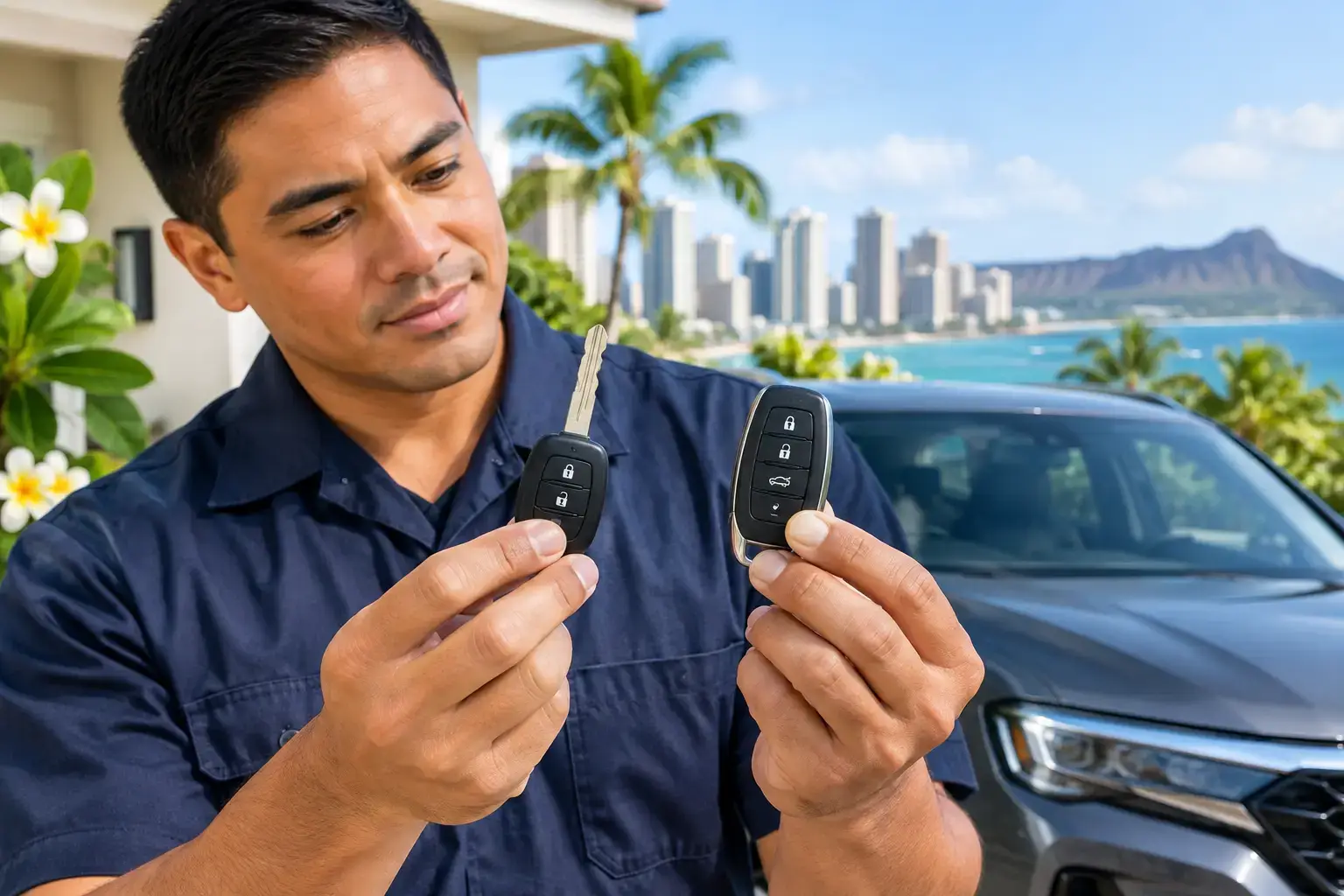
A transponder key needs to be inserted and turned in most vehicles. A smart key usually stays in your pocket or bag while you unlock and start the car. When comparing a transponder key versus smart key , the right answer depends on how your vehicle is built, not which key looks more modern.
Key Takeaways
- A transponder key has a small electronic chip inside the plastic head of the key.
- A basic transponder key may only unlock the door and start the vehicle.
- For daily driving, a smart key is usually more convenient.
- Lost keys are the obvious problem, but keys can also stop working after a drop, water exposure, wear, or a weak battery.
- Replacing either type of key usually involves two separate jobs.
Overview
A transponder key needs to be inserted and turned in most vehicles. A smart key usually stays in your pocket or bag while you unlock and start the car. When comparing a transponder key versus smart key, the right answer depends on how your vehicle is built, not which key looks more modern.
That difference matters when a key is lost in a Waikiki parking structure, a fob stops working in Hawaii Kai, or your car will not recognize the key at all. Both key types contain electronic security parts. Neither is simply a piece of metal that can be copied at a hardware counter.
Transponder Key Versus Smart Key: The Main Difference
A transponder key has a small electronic chip inside the plastic head of the key. When you turn the key in the ignition, the vehicle reads that chip. If the chip's code matches the vehicle, the engine is allowed to start. If it does not match, the car may crank but not start, or it may not crank at all.
The word transponder comes from the chip's job: it receives a signal from the vehicle and sends back an identifying code. The metal blade still turns the ignition and opens the door, but the chip is what lets the engine run.
A smart key is typically a proximity fob used with push-button start. With the fob nearby, you can often unlock the door by touching the handle and start the vehicle by pressing the brake and start button. The vehicle and fob communicate wirelessly at close range. Many smart keys also have a hidden emergency key blade for a manual door lock.
Put simply, a transponder key is usually inserted into an ignition. A smart key is usually detected while it remains on you. There are exceptions, especially on vehicles that use a key fob with a physical blade or a slot where the fob can be inserted.
What Each Key Can Do
A basic transponder key may only unlock the door and start the vehicle. Some versions add remote buttons for lock, unlock, trunk, or panic functions. That is why people sometimes call it a key fob even though the starting system still uses a traditional ignition cylinder.
A smart key generally handles more functions. It may provide proximity door access, push-button start, remote lock and unlock, a remote trunk release, and sometimes remote start where equipped. The convenience is real, especially when you are carrying bags, a child seat, or beach gear.
Smart keys also add more electronics. More features can mean more possible trouble points, including a weak fob battery, moisture damage, a damaged circuit board, or a vehicle-side antenna problem. A smart key is not automatically harder to replace, but it often requires more vehicle-specific programming steps than a standard transponder key.
The Emergency Blade Is Not the Whole Key
A common surprise is finding the hidden key blade inside a smart fob and assuming it will start the car. In most cases, it will only open the door manually. The vehicle still needs to recognize the electronic smart fob before push-button start will work.
If the fob battery dies, many vehicles have a backup recognition method. It may involve holding the fob close to the start button or placing it in a designated area. The exact method varies by vehicle, so check your owner's manual when you still have access to it. Avoid forcing the hidden blade into a lock or ignition if it does not fit smoothly.
Which Key Is More Convenient?
For daily driving, a smart key is usually more convenient. You can keep it in a pocket or purse, and the vehicle can recognize it when you approach. This is useful for families, busy commuters, and drivers making frequent stops around Honolulu.
A transponder key is simpler to use and often simpler in physical design. You put it in the ignition, turn it, and drive. Some drivers prefer that straightforward routine, particularly when they do not want to depend on proximity features or keep track of a larger fob.
Convenience is not the only deciding factor. Your vehicle determines which system it uses. You cannot generally change a traditional transponder-key ignition into a smart-key push-button system with a new fob alone. That type of conversion can involve ignition, security, wiring, and compatibility issues.
Common Problems With Transponder and Smart Keys
Lost keys are the obvious problem, but keys can also stop working after a drop, water exposure, wear, or a weak battery. Oahu's humidity and salt air can be hard on metal contacts, remote buttons, and door locks, particularly for vehicles parked near the coast. A key that works only sometimes deserves attention before it leaves you stranded.
With a transponder key, a worn blade may no longer turn the ignition correctly. The electronic chip can also fail or lose programming after damage. If the vehicle starts with one key but not another, that can point to a problem with the nonworking key rather than the vehicle.
With a smart key, a dead coin-cell battery is a frequent cause of trouble. Replacing the battery may restore remote functions, but it will not fix a broken fob, lost programming, or a vehicle system fault. If the car displays a message that no key is detected while the fob is present, the problem needs proper diagnosis.
Do not assume a remote that unlocks the doors can also start the vehicle. Lock and unlock buttons may work even when the immobilizer system, the anti-theft system that verifies the key before starting, does not recognize the key's starting credential.
Replacement and Programming: What to Expect
Replacing either type of key usually involves two separate jobs. First, there is the physical key or fob itself. Second, there is programming, which matches the key's electronic identity to your vehicle's security system.
For a transponder key, programming allows the chip to communicate with the immobilizer. For a smart key, programming pairs the proximity fob with the vehicle so its access and push-to-start functions work as intended. In many cases, a mobile locksmith can cut the emergency blade, supply a compatible key or fob, and program it on site.
The vehicle's year, model, existing key situation, and condition all affect the process. Some vehicles allow an additional working key to be programmed more simply. A complete all-keys-lost situation may require more steps. Some parts may need to be ordered, which is worth keeping in mind on an island where many automotive parts arrive from the mainland.
You should be ready to show identification and proof that you own or are authorized to use the vehicle. This is especially relevant for a rental car. If you are visiting Oahu and lose a rental smart key, contact the rental company first because it controls authorization and may have its own required process.
A Spare Key Is Worth Planning Ahead For
If you still have one working key, that is often the best time to arrange a spare. A spare transponder key can help when the original blade wears out or the chip is damaged. A spare smart key gives you a backup when a fob is misplaced, wet, or left inside the vehicle.
Keep the spare separate from your daily key. Leaving both keys in the same vehicle or the same bag does not help much when that bag goes missing. For condo residents, a secure place inside the unit is usually better than a vehicle console exposed to heat and humidity.
When to Call for Car Key Help
Call for help if your key is lost, broken, stuck in the ignition, no longer recognized by the vehicle, or if the vehicle will not start after basic battery checks. A technician can identify whether you need a new transponder key, a smart key fob, key programming, ignition repair, or a different solution.
If you are locked out, do not pry at the door frame or force the lock. Modern doors, weather stripping, and electronic handles can be damaged easily. If a key is broken in the ignition or door lock, avoid pushing it farther in.
For car key replacement or programming anywhere on Oahu, Kama'aina Locksmith is bonded and insured and open 24 hours a day, 7 days a week. Call (808) 202-3257. We give you an arrival window when you call, and the full price is quoted on the phone before dispatch, including any service-call fee. A working spare key and a clear plan now can save a stressful stop later.
Talk to a local locksmith
Need help now? Kama'aina Locksmith is bonded and insured, open 24 hours a day, 7 days a week, and quotes the full price by phone before a technician is dispatched. Call (808) 202-3257 and we will give you an arrival window for anywhere on Oahu.
Need Help? Call a Local Locksmith
Kama'aina Locksmith: bonded & insured since 2012, with a typical 20-30 min response across Oahu.
Call (808) 202-3257